


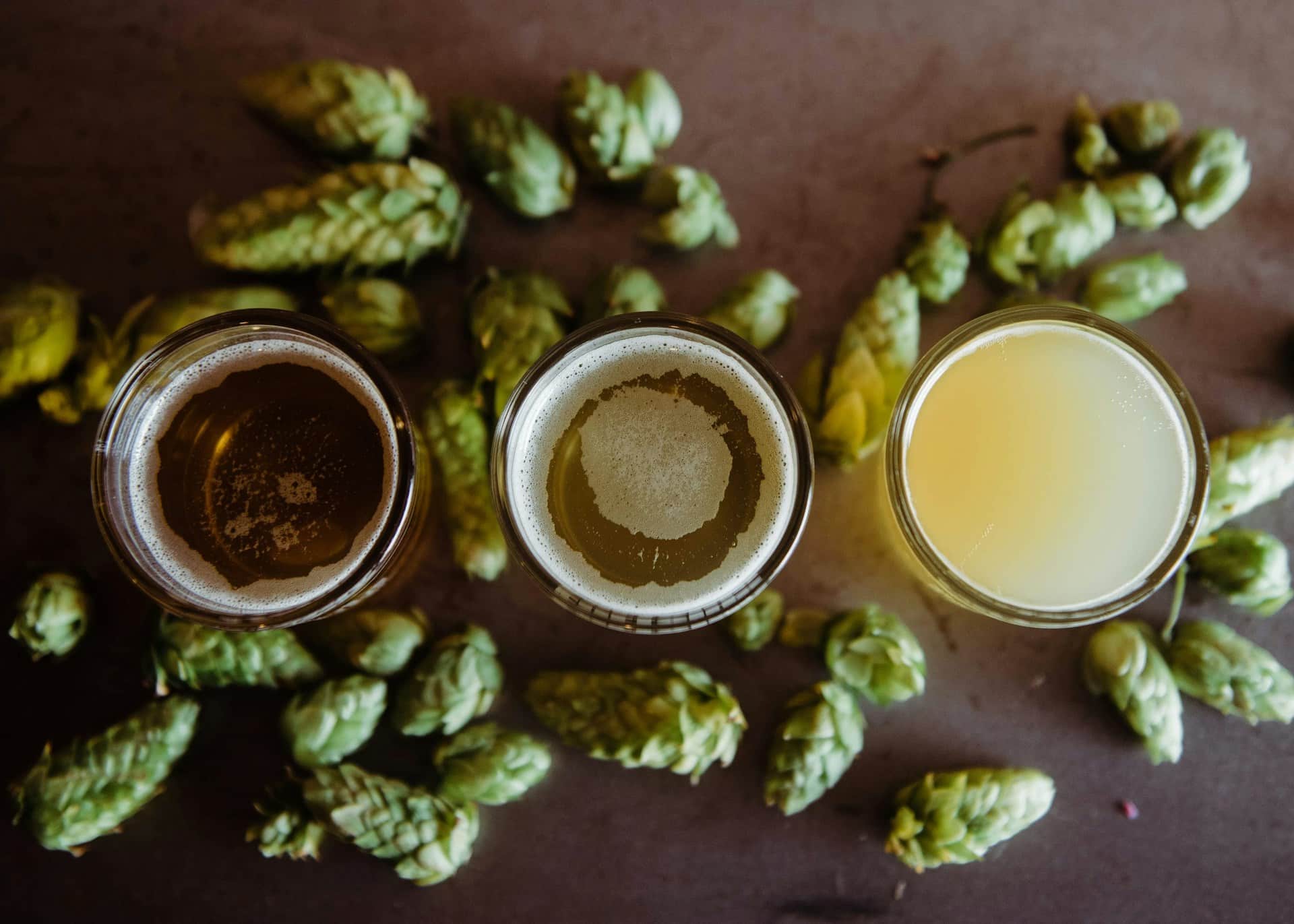

Behind every good beer lie a few essential ingredients… but only one is responsible for that unmistakable bitter note that sets a well-poured pint apart: hops. Although they often go unnoticed compared to malt or yeast, without them beer would be a completely different drink. We’ll tell you exactly what they are, what they bring to your favourite beer, and a few interesting facts you probably didn’t know.
Hops are a climbing plant whose scientific name is Humulus lupulus. They grow naturally in Europe, Asia and North America, and have been used since ancient times in both cooking and medicine for their sedative and bacteriostatic properties. Interestingly, they belong to the Cannabaceae family, making them close relatives of hemp, although their properties are completely different.
What really interests the brewing world is its flower: a small green inflorescence, resembling a miniature pineapple or artichoke, which conceals lupulin within. This substance, rich in alpha acids, is the true star of the story.


The role of hops is threefold and absolutely crucial:
They also help give the head more body and keep the bubbles closer together. The brewmaster decides which combination of hops to use and when to add them to the wort, thereby controlling the level of bitterness —measured in IBUs— and the aromatic profile.

All this aromatic richness comes to life at La Fábrica Cruzcampo in Málaga’s Soho district, our microbrewery in the city’s most artistic neighbourhood. Here, our master brewers craft over 30 varieties a year, experimenting with more than 30 types of malt and hops — and even daring ingredients such as seawater, plankton and kumquat.
The result is Cervezas del Soho, where hops take centre stage in every style: Duende, our refreshing, bitter and aromatic IPAs, where hops reign supreme; Malagueta, Soho’s first craft beer, a light and aromatic APA; and Descará, limited-edition batches featuring our wildest recipes. And alongside them, the Mijilla, the Salerosa, the Arrecía, the Sembrá, the Coraje and the Reliá: nine constantly evolving families, spread across seven taps that are always changing. If you want to truly understand what hops can do, there’s no better plan than popping into La Fábrica, watching the brewing process live and enjoying a freshly poured craft beer. We’ll be waiting for you in Soho, beer in hand. No, not at all.
Tags: Cerveza artesanal